I’ve been working as an Animation Designer for eight years now, and along the way I have evolved my process into a holistic exploration of the discipline.
Each project has broadened my understanding of how animation can act as a design language. My creative processes comprises of decisions that shape the form and function of each project.


To emphasize my design thinking on the individual projects, this case study categorizes my works into three broad categories:
Visual narrative | Technique exploration | Research and experimentation


Building a visual narrative is often my first step in the animation process.
It involves defining a visual style and aesthetic that complements the tone and structure of the content. The aim is to both amplify the story and create visual harmony.
In a Deepfake explainer video, I chose brand colours and a scribble-style character design to create a light, approachable tone that made complex information feel more elementary and accessible.

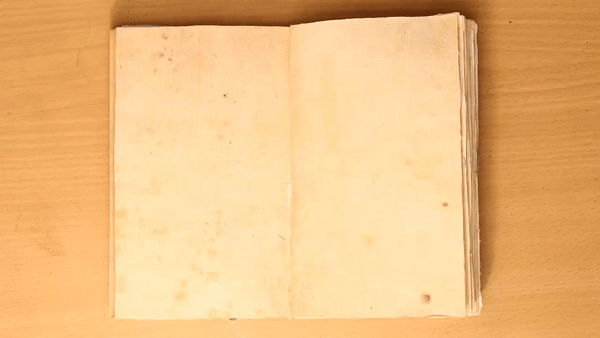
For my degree project short film Poetry, I intentionally used paper elements for motion to visually manifest poetry emerging from the pages.

In a poster animation based on the documentary Kamali, I opted for a more realistic character design that bordered on a motion comic. The visual narrative here drew parallels with the live action medium.


The feasibility of a compelling visual narrative is tied to the technical exploration.
My primary tools are After Effects, Rive, and hand-drawn animation techniques.
Understanding their technical aspects lets me estimate how much the visual variation is possible.
For an animation for a Windows 98-style Nostalgia generator, I used the CC Ball Action effect in After Effects to simulate a pixelated, grid-like visual.
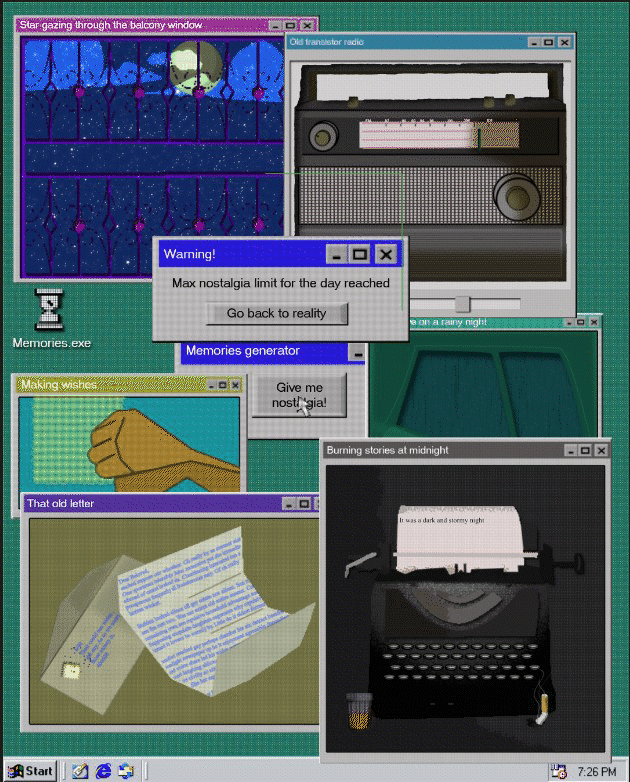
Elements with and without pixilation
The same effect, when paired with Turbulent noise on a hand-drawn animation and a white outline stroke, resulted in a unique halftone paper cutout aesthetic.
While building a full-body character rig in After Effects,
I combined Limber controls with Joysticks and Sliders, allowing all-around control of body shading and strokes.
For the face rig in the same full-body character rig, different eye expressions can be switched based on the Joystick position.
Variations of wave warp effect were used for hair movement.
Background was given a fisheye perspective with warp effect combinations.
Background was given a fisheye perspective with warp effect combinations.

Research and experimentation have remained essential to my process since my time in academia.
This helps to understand how the aspects of the medium can be toggled with to solve a particular motion problem.
A lot of slider permutations went into creating the mouth rig for the full- body character rig

Mouth shape was created with a set of path pointers bound by Nulls. These nulls were used to create extreme mouth positions.
Sliders were created using these extreme positions. Using these,
a joystick was created for all emotions with mouth movement.
Sliders were created using these extreme positions. Using these, a joystick was created for all emotions with mouth movement.


For an animated cover of the graphic novel, It’s Lonely at the Centre of the Earth, I experimented with varying framerates for the motion of different characters to reflect their unique characteristics.
This also indicated that they belonged to their separate universes.

In Kamali Animation, the skirt swirling was a procedural combination of different shade layer movements and wave warp effects on various elements.
In a Paper quill-styled animation, I created editable strips with two shape layers. The outline and the base layer was bound and controlled using Point Follows Nulls. Gradient was applied overall to simulate depth.
For an interactive motion in Rive, I experimented with a dot-to-square interaction in a nested artboard and duplicated it to create an interactive grid.
_gif.gif)
For my degree project short film Poetry, extensive research went into understanding paper manipulation techniques like folding, cutting, stacking. These experiments further evolved to a mix-media animation combining stop motion using paper crafts and digital animation.