I have been part of creative production for 8 years, spanning design and production to management, optimization, and research in high-volume animation production.
In production management, I combine hands-on creative expertise with operational leadership: designing production workflows, managing cross-functional teams, optimising systems, and driving research. Over the span of 5 years of leading, I have been able to scale up the video production from 40 videos to 70 videos per collection. As of now I head the AI production with over 160 video production per month.
My experience in developing effective workflows comes from building and managing both Edtech creative and AI-integrated productions. As a Team lead and Production head, I play a pivotal role in:
Workflow management | AI integration | Optimization | Research
Workflow Management
It involves defining a visual style and aesthetic that complements the tone and structure of the content. The aim is to both amplify the story and create visual harmony.
My initial workflow experience came from directly visualizing content — categorizing and reviewing script and storyboard elements into live action and animation visuals.


Over time, I moved toward managing more complex workflows involving style generation, asset creation, and a review-feedback loop across cross-functional departments.
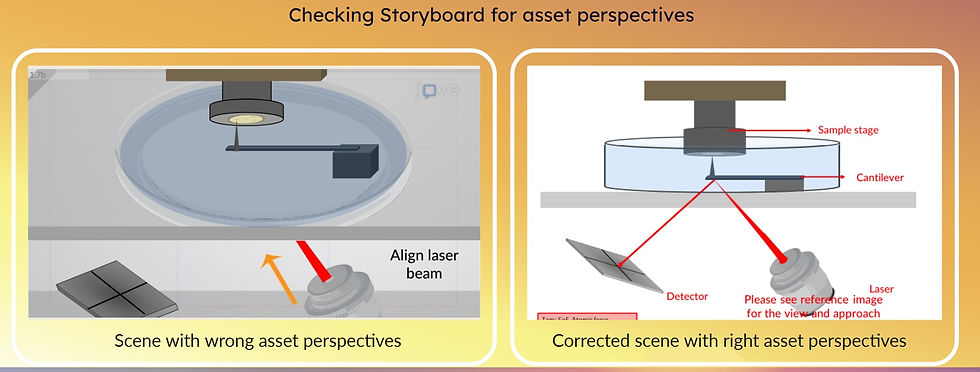
In an edtech production where factual accuracy is non-negotiable, a structured review-feedback loop becomes essential. It also allows me to assess content at the storyboard stage, evaluate the visual flow, and determine how feasible certain visuals are given the tools available in production.
Planning style guides is a critical step before initiating a collection. All repeating assets related to a collection need to be previsualized including designingand animating for text boxes, headers, and other UI elements like insets.


Additional pre-production guides, such as animatics guidelines, are created to define specific production standards before work begins.
.jpg)

AI Integration
As a production lead, I played a key role in the initial adoption of AI tools and processes for video production. Over time, we developed methodologies for an end-to-end video production pipeline built on human and AI collaboration.
A methodology is developed to create a consistent character sheet to maintain character continuity.

Reference sketches from animatics are then used to create the scene images. Various prompting techniques are used to maintain a certain aesthetic.

.jpg)
This experience gave me a clear perspective on how AI performs better as a tool rather than a replacement. Human intervention in AI production makes the process growth-oriented. Over time, the team develops better prompting strategies and referencing techniques that progressively improve output quality.

New prompting methods developed as an optimization technique, that genereted better outputs in video generetion
The Scene images are then prompted further to create videos using video tools such as Veo.
Optimization
Optimization refers to the in-between processes and techniques that stabilize and accelerate a production pipeline. Monitoring production from a macro view is an important part of my role, as it helps pinpoint where specific processes need refinement.
Animation Techniques
Using techniques that present information in parallel helps increase information exposure without extending animation duration. These techniques are production-specific and are developed in response to the needs of each project.

Template Creation
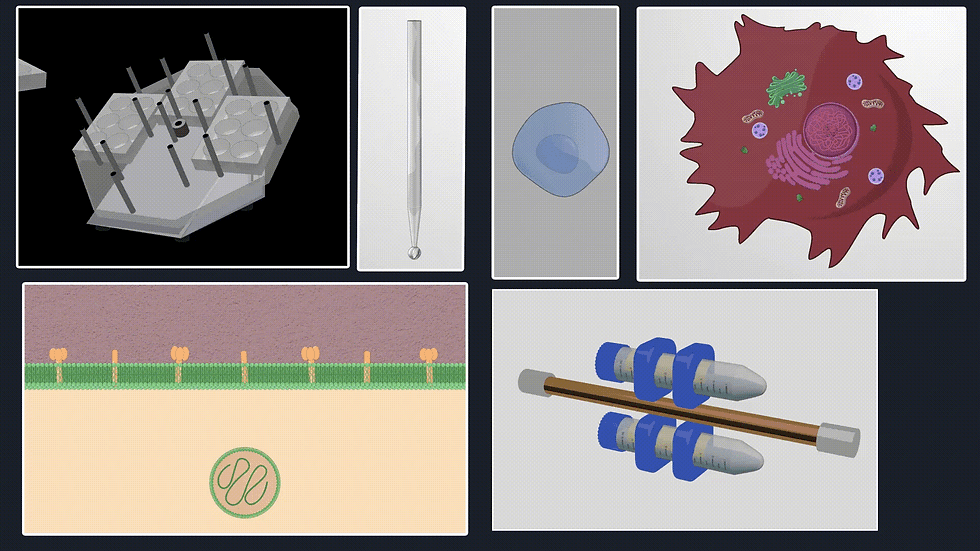
Identifying recurring patterns in production and building a library of reusable animations and assets is another important aspect of long-term optimization.
Training
In AI production, I develop training materials to help the production team better incorporate animation techniques into the workflow. I also create materials for subject matter experts to help them understand visualization principles more effectively.
Production Checklists
Production checklists are visual references that outline what to avoid in visuals so that output stays aligned with established guidelines. They are particularly important for setting quality standards and reducing revision cycles. This became especially critical during the transition to AI production, where many visual elements are auto-generated and require active correction.
.jpg)
.jpg)
Customization
In production I made sure we emloyed customizable templates which could be manipulated and controled easily in After effects. For instance, this inset template that I developed which had easy controls for faster usage.
Training presntation I created to explain how the 12 principles of animation can be used in our animaton production.

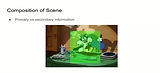
Training on the theory of visualization explaining compositon, framing, and narrative structure.

Project Organization
Another optimization process involves creating a structured organizational hierarchy for all files associated with a project. This facilitates smooth project handoffs between teams.
Research also extends into building tools that directly support production. For the AI production pipeline, I developed a storyboarding tool that creates a storyboard, categorizing and visualizing parts of scripts into info graphics, character scene (scenes with charcters) and B-roll (only background scenes).
It allows the users to upload, character guides, style guides and images from any visual style as reference, along with a script. The tool then extracts keywords from the images and uses them as prompts to generate a storyboard with visuals.
This was an exploratory prototype, and the insights from it drove further research into developing more advanced storyboarding tools.
Research
Research has been one of the most personally rewarding aspects of leading production. In this context, research involves gathering data and building reports that help identify problem patterns and their frequency within the pipeline.
